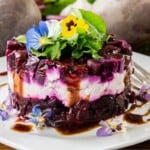
Beet Napoleons with Garlicky Balsamic Vinaigrette
Beet Napoleons with garlicky balsamic vinaigrette make an elegant salad or appetizer. This is a delicious and clever recipe for using the beets and greens you receive in your community supported agriculture box or farmer's market!
Servings: 2 Napoleons
Ingredients
For the Garlicky Balsamic Vinaigrette
- 2 tablespoons raw honey
- 1 tablespoon Dijon mustard
- ½ teaspoon Kosher salt
- ½ teaspoon freshly cracked black pepper
- 1 large clove garlic
- ¼ cup quality balsamic vinegar
- ¾ cup quality olive oil
For the Beet Napoleons
- 1 pound whole red and golden beets scrubbed clean and dried
- 6 ounces goat cheese with herbs or honey
- many small frisée or mâche leaves
- 3 tablespoons quality olive oil
- 1 good pinch Kosher salt
Instructions
Preparing the Vinaigrette
- Add all the dressing ingredients to a blender or food processor and process for 1 minute, or until it's smooth and emulsified. Process for 30 seconds more just before drizzling over Napoleons.
Roasting the Beets
- Preheat oven to 350°F.
- Trim the beets to about 1 inch of the greens. Toss whole, in a large bowl with olive oil and a good pinch of Kosher salt. Turn out onto a large sheet of aluminum foil. Draw the foil in to create a pouch and seal it. (If using more than one color of beet, roast the colors separately in different aluminum baking pouches so the colors do not bleed together during roasting.)
- Roast the beets in the pouches on a baking sheet for 1 hour, or until a knife is easily inserted into the biggest beets.
- Allow beets to cool for only 15 minutes before 'peeling.' The skins will come off easily while the beets are still somewhat warm, so latex dish gloves help in this step. The skins should easily peel away with gentle rubbing. A knife may also be used if preferred. (If using different color beets, peel the darkest beets last.) It's okay if all of the skins do not come off, but try to get most of the skins. Discard the beet tops.
- Rough chop the beets into a 1/4 to 1/2 inch dice. Keep different colors separate, and rinse your knife in between colors.
Assembling the Napoleons
- Cut two, 6-inch squares of waxed paper or parchment and place on your serving plates. Place the presentation ring or biscuit cutter in the center of the waxed paper and set aside. (If you only have one ring or cutter, you will need to prepare each Napoleon separately.)
- Working inside the presentation ring or biscuit cutter, begin the base layer of beets. Scatter and press in gently so as to fill all edges and gaps, the base layer of beets. You may need to use a small spoon to get the pieces where you want them - it's a process. Build your base layer to about 1/2 to 3/4 inches tall.
- Using a clean small spoon, drop half of the goat cheese in small dollops atop the base layer of beets, filling all of the gaps and spaces. Using the back of that spoon or your fingers, gently press the goat cheese into the base layer. Do not pack the cheese down hard, rather press down but do so loosely. Only the outside of this cheese layer will be seen once assembled, so there's no need to smooth it out.
- Follow with the last layer of beets, again being sure to fill fill all edges and gaps. Again, only the outside of this beet layer will be seen once assembled so do not be concerned that the pieces are uneven on the top.
- Gently pull the waxed paper from beneath the Napoleon. Discard the waxed paper.
- Once both Napoleons are assembled, add 1 tablespoon of the vinaigrette to the top of each, allowing the dressing to spill down and fill and flavor any interior nooks and crannies.
- Highlight the top with beautiful frisée or mâche leaves and additional vinaigrette spooned over the greens and drizzled down the sides of the Napoleon. Serve with soft warmed yeast rolls and softened assorted compound butters.
Video
Notes
- You will be assembling the Napoleons on the plates you will be serving from, so be sure to line them with waxed paper or parchment before you begin.
- You will need a 3.25x1.5 inch (or slightly larger) stainless steel presentation cooking ring or biscuit cutter to achieve the 'tower'.
- If using a presentation ring, use the food press included with the ring to push the Napoleon down while you lift the ring up and off the Napoleon. If using a biscuit cutter, use the back of a wide spoon to push the Napoleon down while you lift the ring up and off of the Napoleon.
- Using latex dish gloves to 'peel' the beets after roasting will prevent your fingertips from staining.
- If not serving immediately, the Napoleons may be refrigerated, assembled, but not dressed with the vinaigrette, for several hours. Remove from the refrigerator 1 hour before dressing and serving.
Nutrition
Serving: 1serving | Calories: 1324kcal | Carbohydrates: 46g | Protein: 20g | Fat: 121g | Saturated Fat: 27g | Polyunsaturated Fat: 11g | Monounsaturated Fat: 79g | Cholesterol: 39mg | Sodium: 1358mg | Potassium: 831mg | Fiber: 7g | Sugar: 38g | Vitamin A: 962IU | Vitamin C: 12mg | Calcium: 176mg | Iron: 5mg